
The Gravity of the Situation
There is a specific, terrifying kind of silence that descends upon a locomotive cab when you realise the train is pushing you, rather than the other way around. In Alpine Freight 47, this realisation usually hits somewhere near the crest of a snowy New Zealand alpine pass, just as the gradient shifts from a punishing climb to a treacherous descent. It is in these moments that the game reveals its true nature. This is not merely a train driving simulation; it is a meticulous, high-stakes puzzle of physics, momentum, and foresight. You are not just operating a vehicle; you are attempting to negotiate with a living, breathing machine made of steel, air pressure, and raw kinetic energy.
The premise of Alpine Freight 47 is straightforward enough for any logistics enthusiast: haul massive tonnages of freight across rugged, unforgiving terrain. Available on PC and Xbox Series consoles, the game positions itself as a serious simulation that bridges the gap between impenetrable realism and accessible gameplay. The core gameplay loop revolves around managing your locomotive's complex systems while reading the route ahead. A perfect run is one where the brake pressure remains stable, the couplings stay intact, and the massive consist of freight wagons arrives at the yard without having turned into a runaway disaster.
What immediately sets the game apart from its contemporaries is its profound dedication to brake and consist modelling. In many train simulators, braking is a simple matter of pulling a lever and watching the speed drop. Here, the air brake system is simulated with daunting fidelity. You must manage the main reservoir, the brake pipe pressure, and the independent locomotive brakes, all while accounting for the propagation delay—the time it takes for a brake application to travel from the lead locomotive to the very last wagon in your consist. Apply the brakes too aggressively, and you risk a catastrophic derailment. Apply them too gently on a steep downhill grade, and you will quickly find yourself accelerating beyond the point of no return.
Mastering the Cab HUD
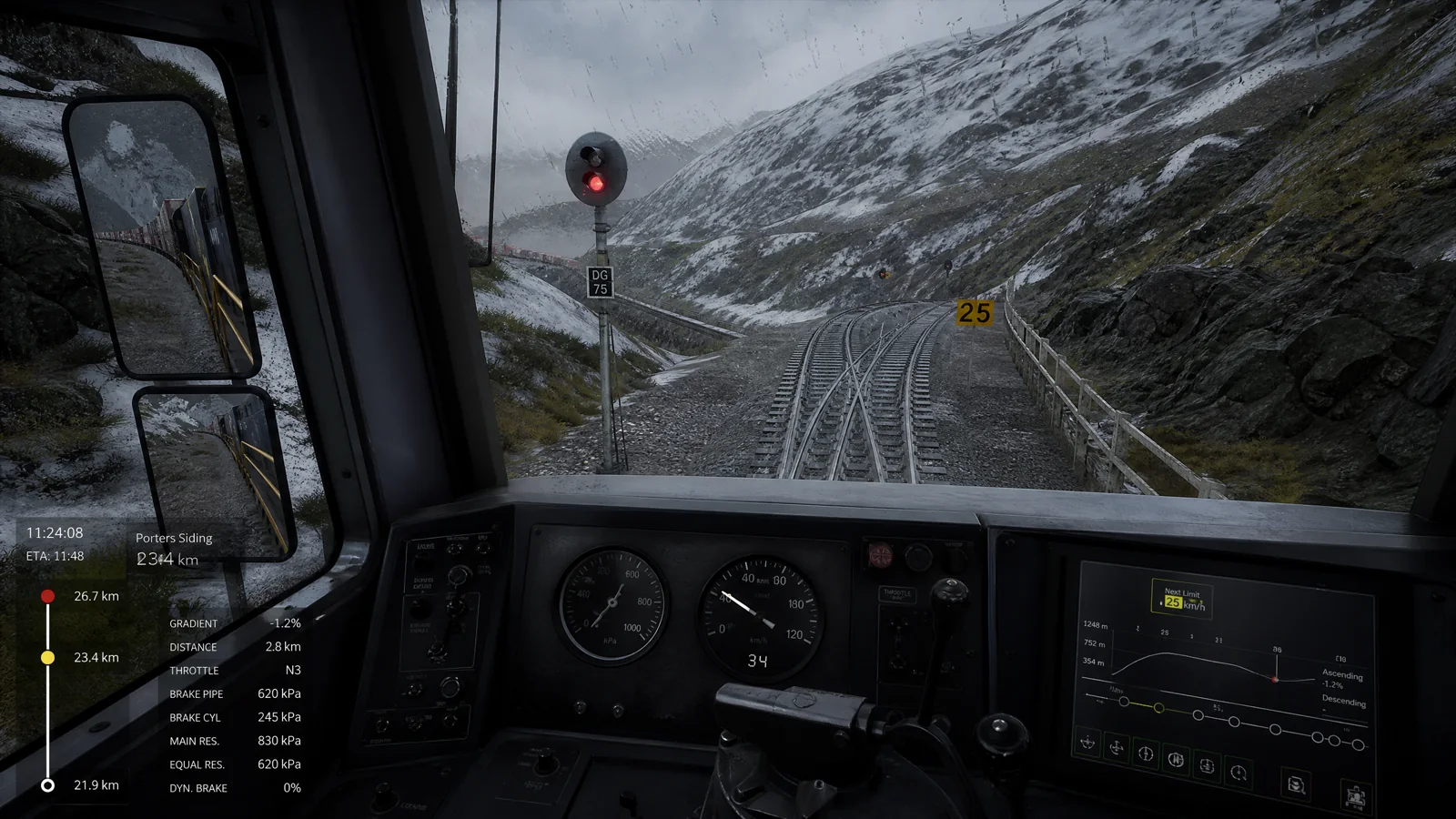
The developer has crafted an interface that provides all the necessary information without overwhelming the player. The gameplay HUD is a masterclass in functional design, seamlessly integrating into the immersive environment of the locomotive cab. When you are descending that snowy alpine pass, your eyes will constantly dart between the frost-fringed windshield and the critical readouts. The HUD elegantly displays brake cylinder pressure, throttle notch, dynamic brake effort, and an invaluable route gradient profile that stretches out before you.
This route gradient profile is perhaps your most important tool. It allows you to anticipate changes in elevation and adjust your speed long before you reach them. The HUD also highlights upcoming track switches, speed limits, and signal states, ensuring that you are never caught entirely off guard. However, the game demands your undivided attention. A momentary lapse in concentration can easily lead to a situation where your train's momentum overwhelms your braking capacity.
"The true challenge of Alpine Freight 47 isn't reaching your destination; it's proving to the mountain that you can respect its gravity without surrendering to it."
Controls on both the PC and Xbox Series are surprisingly intuitive, considering the depth of the simulation. On a controller, the analog sticks provide nuanced control over the throttle and dynamic brakes, while the d-pad handles the more granular adjustments to the automatic air brake system. PC players using a keyboard and mouse will find the traditional hotkeys responsive and logical. The tactile feedback of notching up the throttle or making a minimum reduction on the brake pipe adds immensely to the immersion.
Performance in the Snow
Visually, Alpine Freight 47 is a striking experience. The New Zealand alpine environments are rendered with a stark, cold beauty. The dynamic weather system is particularly impressive, with snow accumulating on the tracks and visibility dropping to near zero during heavy squalls. These weather conditions are not merely cosmetic; they have a tangible impact on gameplay. Snow and ice significantly reduce wheel adhesion, making wheel slip a constant threat when accelerating and increasing braking distances dramatically.
Performance on the Xbox Series X is robust, maintaining a steady framerate even when rendering complex freight yards with dozens of highly detailed wagons. On PC, the game scales well across a range of hardware, though maximising the volumetric weather effects and draw distances will require a reasonably modern GPU. The audio design deserves special mention. The groans of the chassis, the hiss of releasing air brakes, and the deep, resonant thrum of the diesel engine working under load create a soundscape that is both authentic and incredibly atmospheric.
Accessibility has clearly been a focus during development, which is a welcome addition to a genre often known for its steep learning curves. The game features a comprehensive suite of tutorials that break down the complex braking systems into digestible, interactive lessons. For players who want a more relaxed experience, there are options to simplify the physics, automate the coupling process, and enable on-screen prompts that suggest optimal throttle and brake settings. These assists ensure that the game remains teachable, allowing newcomers to gradually peel back the layers of complexity at their own pace.
The Grind of the Rails
Despite its many triumphs in simulation and atmosphere, Alpine Freight 47 is not without its limitations. The most glaring issue is the pacing of its career mode. While the core act of driving is endlessly engaging, the structure built around it can feel overly restrictive. Players are required to complete a significant number of repetitive, low-stakes shunting and short-haul assignments before unlocking the truly spectacular, long-distance alpine routes that define the game's appeal. This means that the route variety, which is excellent once fully unlocked, arrives far too late in the progression curve.
To succeed in the challenging alpine descents, players must master several critical systems:
- Dynamic Braking: Utilising the locomotive's traction motors to resist momentum, crucial for maintaining a steady speed.
- Air Brake Management: Balancing the brake pipe pressure to apply consistent stopping force across the entire consist.
- Slack Control: Managing the tension between wagons to prevent harsh run-ins or run-outs that can cause derailments.
- Adhesion Monitoring: Watching for wheel slip in adverse weather conditions and applying sand to the rails.
Final Approach
Ultimately, Alpine Freight 47 succeeds brilliantly at what it sets out to do: simulating the immense weight and power of heavy freight operations. It transforms the act of slowing down into a thrilling, white-knuckle experience. The depth of the brake and consist modelling is unparalleled, offering a level of mechanical intimacy that simulation fans will adore. The fact that it manages to remain teachable and accessible to newcomers is a testament to its thoughtful design and excellent tutorials.
While the career progression could benefit from a significant overhaul to introduce route variety earlier, the moment-to-moment gameplay is strong enough to carry the experience. When you are perched in the cab, battling a blizzard on a 2.5 percent downgrade, carefully feathering the dynamic brakes while monitoring the air pressure of a mile-long consist, the game's structural flaws fade into the background. It is a demanding, deeply satisfying simulation that earns its place among the genre's best, provided you have the patience to weather the initial grind.