
The Winds of Change in Tactical Combat
There is a distinct moment in Red Tussock Protocol when you realise the environment is not merely a static backdrop, but an active participant in your survival. Set against the sweeping, golden-red landscapes that evoke the rugged high country of Aotearoa, this turn-based squad tactics game introduces a variable that fundamentally shifts how you approach every engagement: the wind. It is a mechanic that sounds deceptively simple on paper, yet in practice, it completely upends the traditional formula of finding cover and trading shots. For a genre that often relies on predictable mathematical outcomes, the introduction of shifting gales breathes fresh life into every tactical decision.
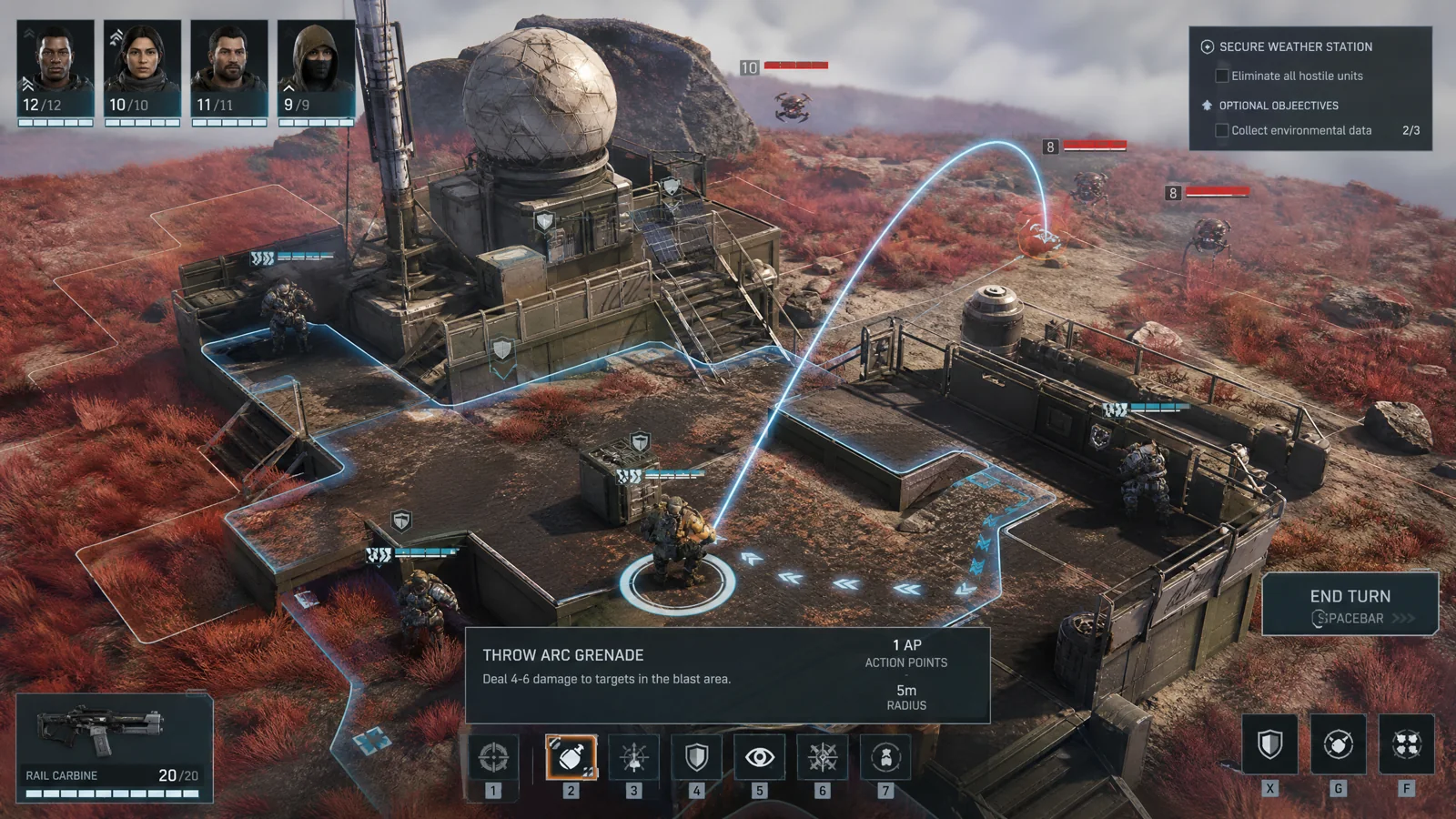
Developed for PC and PlayStation 5, Red Tussock Protocol drops players into the boots of a four-person squad tasked with securing vital weather stations across a fractured landscape. The isometric perspective is familiar, complete with the standard grid of movement tiles, action points, and ability arcs that fans of the genre will instantly recognise. However, the moment the hostile drones begin their approach, the true genius of the game's design reveals itself. The wind direction is constantly displayed at the edge of the screen, and it dictates everything from the trajectory of your smoke grenades to the movement patterns of the enemy forces. It forces you to constantly re-evaluate your positioning and adapt your strategy.
The core gameplay loop revolves around managing your squad's action points while navigating the treacherous terrain. Each character has a specific role, but their effectiveness is heavily dependent on how well you can read and utilise the environment. For instance, throwing a smoke grenade upwind will result in a thick, protective cloud that drifts perfectly over your exposed sniper, while a poorly timed toss downwind will simply obscure your own vision. This dynamic system ensures that no two encounters ever feel exactly the same, as a sudden change in wind direction can turn a perfectly fortified position into a death trap within a single turn.
Systems and Mechanics That Demand Attention
What truly sets Red Tussock Protocol apart is the sheer depth of its environmental interactions. The tall, swaying red tussock grass provides excellent visual cover, but its effectiveness is tied directly to the wind. A strong gale can flatten the grass, exposing your squad to the optical sensors of the approaching drone swarms. Conversely, you can use the wind to your advantage by deploying incendiary rounds to create controlled burns that sweep across the battlefield, forcing enemies out of their entrenched positions. The game demands a level of spatial awareness that goes far beyond simply calculating hit percentages.
The controls on both PC and PlayStation 5 are exceptionally well-mapped, ensuring that the complex layers of tactical information never feel overwhelming. On the PS5 DualSense controller, snapping between targets and cycling through abilities is intuitive, with the haptic feedback providing a subtle rumble that mimics the intensity of the incoming weather fronts. On PC, the mouse and keyboard setup allows for precise targeting of ability arcs, which is crucial when you are trying to thread a shot through a narrow gap while compensating for a crosswind. The UI is clean and unobtrusive, keeping the focus squarely on the battlefield.
However, the brilliance of the tactical combat does highlight the game's most notable limitation: the campaign downtime. Between the intense, brain-burning missions, your squad returns to a mobile forward operating base to upgrade gear, heal wounds, and interact with one another. Unfortunately, these segments feel remarkably thin. The narrative framing is sparse, and the character interactions lack the depth required to make you truly care about the squad members as individuals. You are given a few dialogue choices and upgrade trees, but the overarching plot feels like a mere excuse to move you from one brilliant tactical puzzle to the next.
Performance, Pacing, and Accessibility
In terms of performance, Red Tussock Protocol runs beautifully across both platforms. The PlayStation 5 version maintains a rock-solid 60 frames per second, which is essential when panning across the large maps to assess the tactical situation. The lighting engine is particularly impressive, casting long, dramatic shadows across the tussock as the sun dips below the horizon. On PC, the game scales well across a variety of hardware configurations. The visual feedback is crucial, as the swaying grass and drifting particles provide immediate, intuitive cues about the current wind conditions.
Accessibility is another area where the developers have clearly invested significant effort. Recognising that the wind mechanics add a layer of complexity that could alienate newcomers, the game offers a robust suite of customisation options. Players can adjust the frequency of wind changes, enable detailed trajectory previews that show exactly where a grenade will land after wind displacement, and toggle high-contrast modes for better visibility of the movement tiles. These features ensure that the game remains challenging without ever feeling unfair, allowing players of all skill levels to engage with its unique systems.
"The wind is not just a hazard; it is the most powerful weapon in your arsenal, provided you have the foresight to harness it before your enemies do."
The pacing of the combat encounters is meticulously crafted. Early missions gently introduce the basic concepts of wind displacement and cover degradation, allowing you to get comfortable with the core mechanics before ramping up the difficulty. By the mid-game, you are facing massive drone swarms that require you to chain together complex sequences of abilities while constantly adjusting to shifting weather patterns. The sense of escalation is palpable, and the satisfaction of executing a flawless turn is unmatched in the current tactical landscape.
A Masterclass in Tactical Variety
To truly understand the tactical variety on offer, one only needs to look at the diverse array of strategies required to survive the game's most challenging encounters. The hostile drones are highly mobile, coordinated adversaries that will actively exploit the environment against you. If the wind is blowing towards your squad, the drones will deploy toxic gas canisters that drift inexorably towards your position, forcing you to break cover and scramble for higher ground. Countering these tactics requires a deep understanding of your squad's capabilities and the willingness to take calculated risks.
- Environmental Manipulation: Use incendiary weapons to create wind-driven firebreaks that funnel enemies into kill zones.
- Dynamic Cover: Tall tussock grass provides stealth, but strong winds can flatten it, requiring constant repositioning.
- Trajectory Alteration: Grenades, smoke, and certain projectile weapons are physically displaced by crosswinds.
- Drone Adaptation: Enemy AI actively uses the wind direction to deploy drifting area-of-effect hazards.
Ultimately, Red Tussock Protocol succeeds because it dares to introduce a chaotic element into a genre defined by control. The wind mechanics could have easily been a frustrating gimmick, but they are implemented with such care and precision that they elevate the entire experience. Every decision is fraught with tension, and every victory feels hard-earned. The thin campaign downtime is a noticeable blemish, but it does little to detract from the sheer brilliance of the tactical combat. By turning the very air we breathe into a tactical resource, the developers have crafted one of the most innovative and engaging turn-based strategy games in recent memory.